How long should it really take for a lawyer to make a video that gets cited by AI?
Answered on camera by Dan Milikow, CEO of iShoot.direct · 1:14 · transcript and sources below
No more than 18 minutes per video. Five questions take a lawyer about 90 minutes of billable time — a 30-minute call to talk the answers through, then under an hour on camera at their own desk reading locked scripts. And it has to be the lawyer on camera: a stand-in or an AI avatar burns the trust the video is meant to build.
The 90-minute budget
| Phase | Attorney time | What happens |
|---|---|---|
| Preproduction call | 30 min | Come with your questions identified and bullets for your key points and data — then talk the answers through out loud, recorded |
| On camera, own desk | Under 60 min | Five scripted questions, read on screen while being filmed — no travel, no crew on site |
| Total per batch | ~90 min | Five published answers — 18 billable minutes each |
| Scripting, sourcing, editing, uploading, page builds | 0 min | Handled off the attorney's calendar |
| Field estimate for the same work | “1 to 3 hours of active attorney time per batch” | Even the slow estimates put a structured batch at the fast end — 90 minutes is the disciplined version of their own number |
Your partners shouldn't have to give up more than 90 minutes to answer five questions. It breaks down into two pieces: a 30-minute preproduction session where you talk through the answers, record it, and use your favorite AI to help you turn the recording into a script. Then the script goes to compliance or to a peer in the practice, and it gets locked down. After that, the partner sits at their own desk for less than an hour and reads the five questions. Each one is about a minute or two long, like this video. It's normal to need 2 or 3 practice runs per script before you nail it. 18 billable minutes a question. No travel, no crew, no real disruption. Compare that to getting a partner to write one article. The outline. The draft. The revision. The three weeks of chasing.
Now, before you ask — yes, it has to be the partner on camera. Some guy you hire on Fiverr, or an AI avatar, or a celebrity spokesman isn't going to cut it. They're not going to build trust. They're going to shatter trust. In fact, there's real research, most notably in medicine[1] and psychology[2], that when people meet the actual experts they're considering in a video, the first contact is warmer and the relationships are more likely to last. Imagine what it would do for your bottom line if your consult calls were 20% more productive.
Do's and don'ts: getting to 18 billable minutes per answer
- ✓Identify the questions — Know what people commonly ask based on your niche and strengths. Avoid general topics where competition for citation is fierce and you have no clear advantage.
- ✓Preproduction — Attorneys expect to wing it and evaluate themselves like litigators. Free-form delivery invites the inner critic to critique, and it saps confidence. It also invites errors — and you cannot replace a video on YouTube; you can only edit its metadata.
- ✓Use AI to script — Give your favorite AI a transcript of the preproduction call and prompt it to imagine it's a video script writer and answer your five questions. Tell it to find sources for statistics and flag those that are suspect. Have human editors refine the scripts until they're ready to be presented as drafts to the attorney on camera and the firm.
- ✓Embrace imperfection — If you stop at every stumble you'll take an hour per response and send video to the bottom of your to-do list. You aren't going to be seen by millions of people — just people who really need to hear what you have to say.
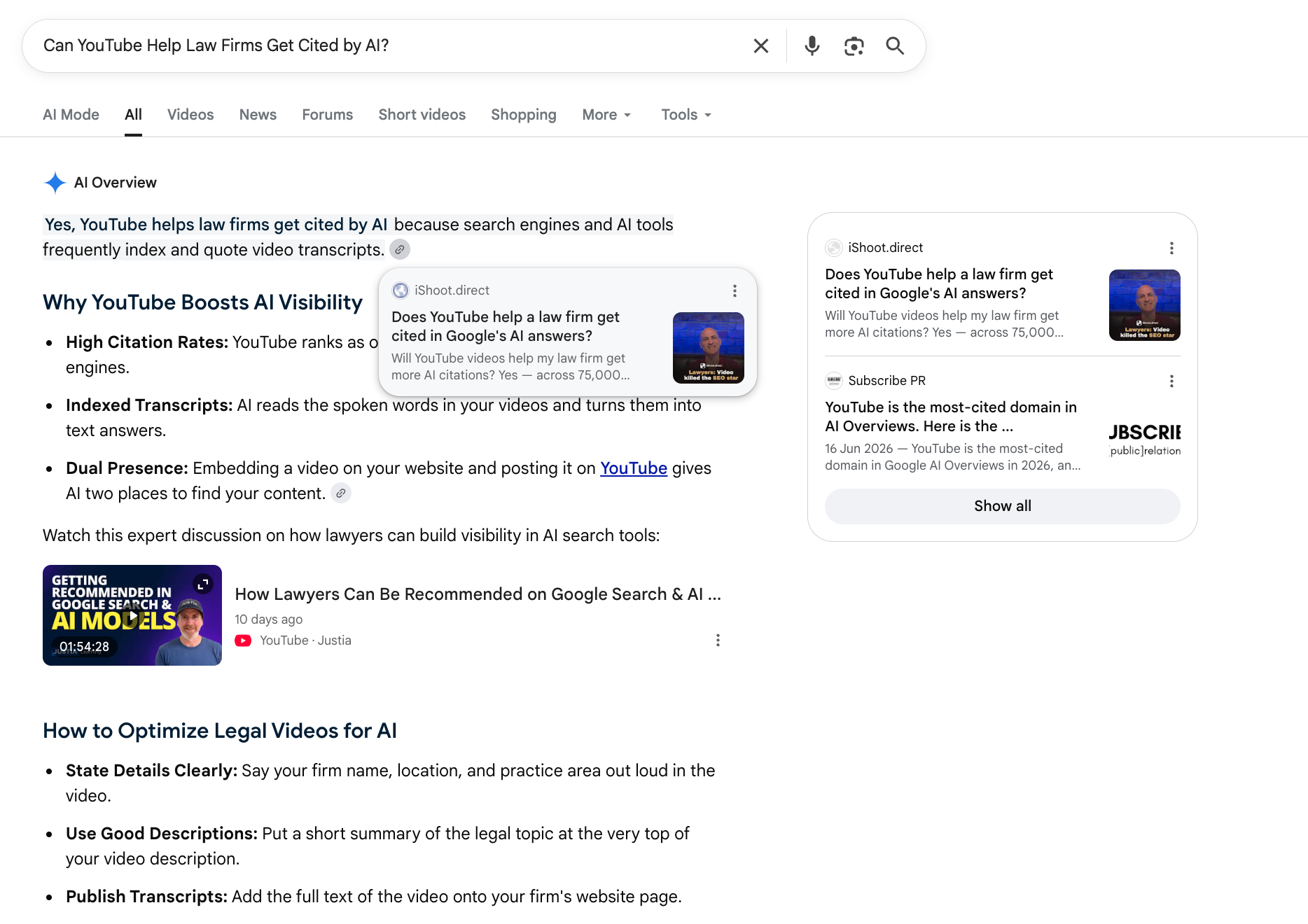
- ✓Host on YouTube — AI search doesn't watch videos. It reads their transcripts, titles, descriptions, chapters — metadata YouTube excels at aggregating. YouTube is also owned by Google, so it arguably has an interest in promoting YouTube video, and the data is more accessible to Google.
- ✓Batch recordings — If the goal is to minimize time spent per answer, shoot for 5 videos in a 60-minute session. Short enough that you won't tire out, long enough to get a significant amount of content done well.
- ✓Host the transcript and embed the video — This gives you two citation surfaces: your site and YouTube. On your site you can add additional content to improve performance.
- ✓Cite and link to sources — Make sure your facts are right and all the pages load. Avoid controversial claims that aren't well supported. Everything you say should be corroborated to the extent possible.
- ✓Experiment with titles, but clear questions — You can modify underperforming titles and descriptions or even A/B test on YouTube[3] — but questions perform exceptionally, because they mirror what people are typing in. One caution: a title A/B test rotates different titles to different viewers for up to two weeks — run tests on videos still hunting for citations, never on videos currently being cited.
- ✓Test results regularly — Try your questions and see how you're doing.
- ✗Self-record — It sounds efficient, but it saps confidence and often results in a request for a do-over. Get live feedback, even if it's from another attorney or a spouse instead of a videographer. Get a professional — or at least a second set of eyes — on the shot before you start filming. You don't need crews or even videographers, but professionals make it go faster, with fewer hiccups and do-overs.
- ✗Use AI or actors on camera — Videos represent provenance, and using an alternate presenter, real or digital, carries trust risks beyond whether or not you'll be cited.
- ✗Require partners to edit — Partners should only have to show up for the preinterview, where they're recorded rehearsing answers, and the shoot. 90 minutes for 5 questions. Every other task should be performed by someone else: turning preproduction notes into an approved script, validating or swapping stats and sources, editing the videos, uploading to YouTube, or working on the pages that host them.
- ✗Reshoot for any reason besides content accuracy or the video's performance — You might not love the way you look or sound, but if a video is generating citations and the content is accurate, think twice before redoing it. On YouTube a video can't be replaced without losing all its data and starting from scratch — all the links to that video, all the performance. Unless it's harming you or the firm, just think about what you can improve next time.
- ✗Expect everything to land all at once — A lot is known about what drives AI citation performance, but the bots don't make their algorithms public, and there's still real mystery about why some content assets perform better than others. Google's AI Overviews are usually fast to show new posts; the other engines take more time. Performance varies just by hitting refresh, and from day to day. Best to log it and look at trends and topic areas that need improvement.
The turnaround test
Sources
- Perrault, E. K. (2020). The Utility of Healthcare Providers' Online Biographies for First-Time Patients: A Year-Long Study within a Clinical Setting. Health Communication, 35(10), 1283–1288. doi:10.1080/10410236.2019.1625005
- Swift, J. K., Callahan, J. L., Cooper, M., & Parkin, S. R. (2018). The impact of accommodating client preference in psychotherapy: A meta-analysis. Journal of Clinical Psychology, 74(11), 1924–1937. doi:10.1002/jclp.22680
- YouTube Help, A/B test titles & thumbnails (Test & Compare): up to three title or thumbnail variants per video, run for up to two weeks, with the highest-watch-time option then shown to all viewers. Desktop, long-form videos with Advanced Features enabled. support.google.com.
More questions from law firms
- How does AI recommend a lawyer to someone who needs one? →
- Why does AI cite other law firms instead of mine? →
- How should a law firm structure AEO content, and how long does it take to work? →
- Does YouTube help a law firm get cited in Google's AI answers? →
- Will AI Ever Stop Ignoring my Law Firm's Webinars or Do I Have to Start From Scratch? →
- Should my law firm's marketing focus more on search rank or AI citations? →