How does video help law firms get cited in AI Overviews?
Answered on camera by Dan Milikow, CEO of iShoot.direct · 0:58 · Updated October 6, 2026
Led Gartner's in-house video studio for over a decade; 30,000+ videos produced since launching iShoot in 2018.
In three ways. It puts your answer on YouTube, which Ahrefs ranks the most-cited domain in Google's AI Overviews[1]. Its title, description, chapters and transcript give AI text it can quote, chapter by chapter[4][5]. And embedded on your site with the transcript, the same answer can be cited in two places, with the attorney visibly behind it.
Watch on YouTube: Does YouTube help a law firm get cited in Google's AI answers?
Can video really help my law firm be cited by AI?
Yes — Ahrefs ranks YouTube the most-cited domain in Google's AI Overviews, ahead of Reddit, Wikipedia, and every publisher[1].
So YouTube actually gives lawyers a big push in being cited by Google's AI answers. Because for starters, it's the most cited domain out there [Editor's note: most-cited in Google's AI Overviews, per Ahrefs.] — ahead of Reddit, ahead of Wikipedia, ahead of every news site and every publisher[1].
Will YouTube videos help my law firm get more AI citations?
Likely — across 75,000 brands, YouTube mentions were the strongest correlate of showing up in Google's AI answers[2].
One study looking at 75,000 brands found that the strongest signal for showing up in Google AI answers isn't backlinks or other popularity metrics. It's mentions on YouTube — in the title, in the description, and in the transcript[2]. Remember, the words your partner says in a YouTube video become a transcript that gets indexed and quoted. And then when you post that transcript on the firm site and embed the video, the same answer is live on two surfaces that are both available for AI citation.
How can I increase the likelihood my law firm's media assets are cited by AI?
Publish each transcript on your own site with the video embedded — the same answer then lives on two citable surfaces, with the attorney visibly behind it.
When AI starts looking past structure at the signals for trust, video delivers another big advantage: clear provenance. Unlike text, which can be copied, pasted and edited without limit, video tells us which attorney is behind the content — because we can see that.
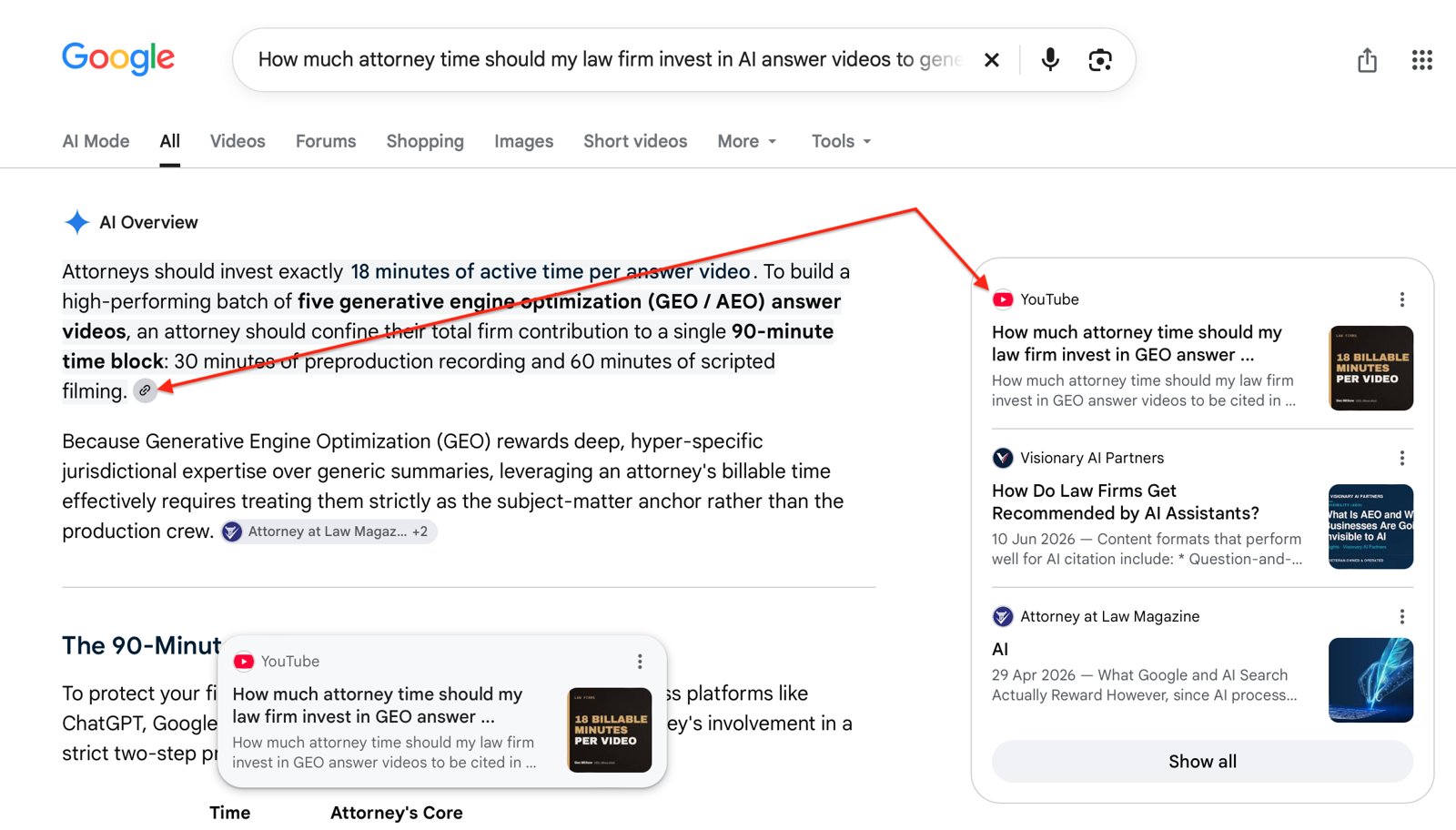
On Sept 27, 2026, a Google AI Overview answered “How much attorney time should my law firm invest in AI answer videos…” and listed iShoot's YouTube video as its first source — not the web page. The Overview's opening line repeated the video's answer: 18 minutes per answer video.
The video gap
On Oct 6, 2026, we put a real client question to Google AI Mode: “I'm in Texas and I might have been going a little above the speed limit, but somebody failed to fully stop at a stop sign and hit me. Can I still recover?” Every source it cited was a Texas law firm's page, and each one named the rule that decides the answer — Texas's proportionate responsibility statute, the 51% bar (Civil Practice and Remedies Code §33.001).
Then we ran the same question in Google's Videos tab. One of the top five results came from a Texas injury firm. Neither its title nor its description named the rule.
| Videos-tab result | Answers the question? | Names the Texas rule? |
|---|---|---|
| Police department PSA on the “move over” law (Facebook, two listings) | No | No |
| Criminal defense firm on beating a hit-and-run charge (YouTube) | No | No |
| Dashcam clip from a Reddit thread | No | No |
| Texas injury firm, “Can I still recover damages when partially at fault?” (YouTube, 2:39) | Yes | Not in its title or description |
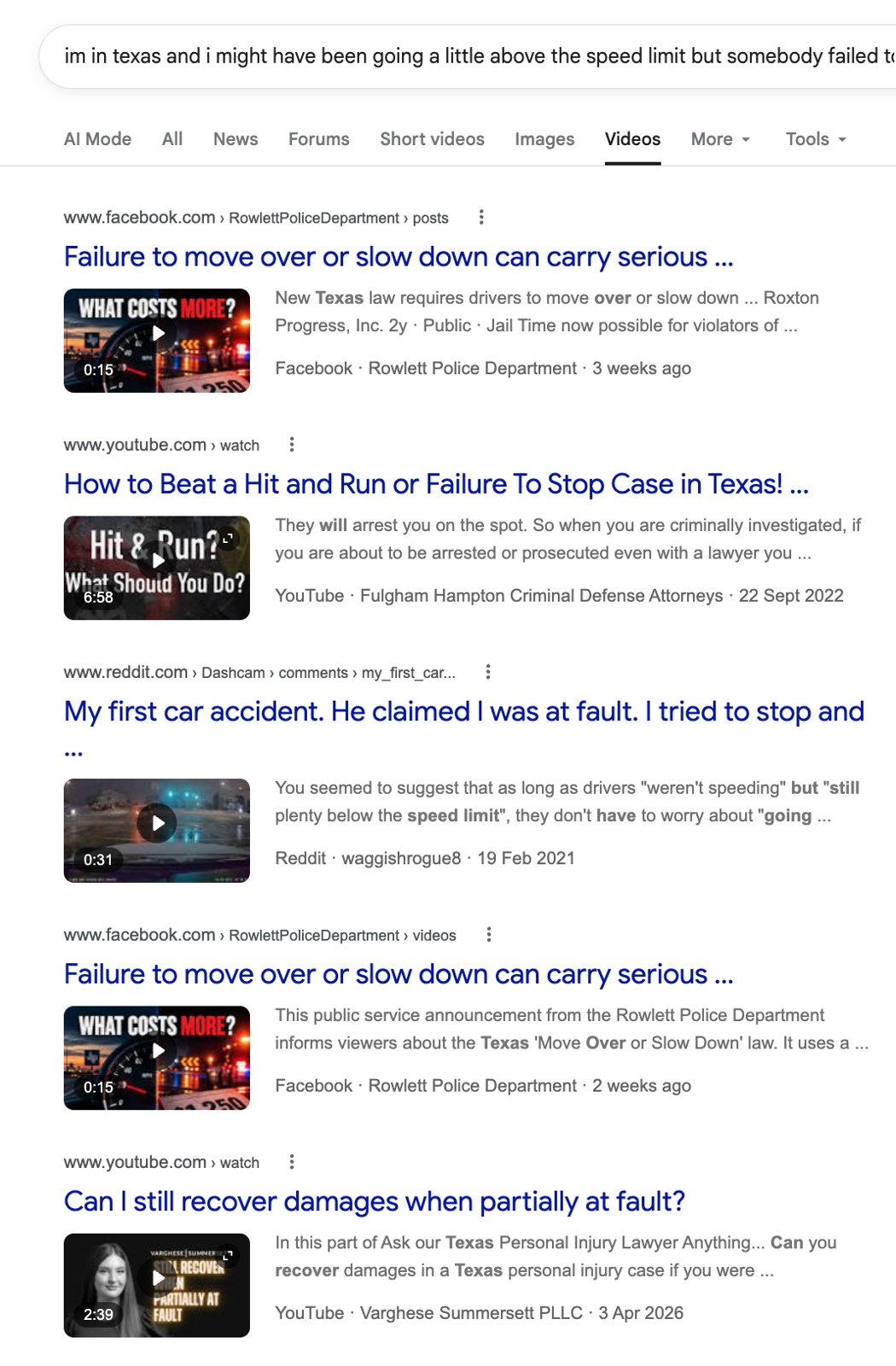
Showing up in video search isn't the same as being cited. The Videos tab matched words; the AI answer matched the question. And the platform matters: in OtterlyAI's study of AI citations from social media, YouTube drew 31.8% — second only to Reddit at 46.4%, ahead of LinkedIn at 13.0%. Facebook didn't make the top three[3].
The pages AI Mode cited put the state and the rule up front — “Texas Comparative Negligence: Partly at Fault? The 51% Rule,” “Proportionate Responsibility in Texas Injury Cases.” No video does.
That's the opening. AI Mode already cites pages that name the rule — but no video does. And YouTube is the single most-cited domain in Google's AI Overviews[1]. So an attorney video that asks the client's question, names the state, and names the rule on camera would be the first to fill that gap — and the first properly structured answer has a strong chance of being cited.
Anatomy of a cite-ready attorney video
- The title is the client's question, in their words — with the state.It matches how people phrase it when they ask AI.
- The attorney names the rule.Say the doctrine and the statute on camera and in the description — “proportionate responsibility, Civil Practice and Remedies Code §33.001” — the way the cited pages did.
- The description opens with the answer, then names the attorney.Two sentences of answer, then the responsible attorney's name, firm and contact information.
- Corrected captions are uploaded.Auto-captions can garble names and statute numbers.
- The attorney is on camera.Viewers can see who stands behind the answer.
- It's uploaded as a regular video, not a Short.See the next section.
- It's embedded on a one-question page with the full transcript.The same answer, on two surfaces that can each be cited.
Length isn't the deciding factor. Among cited videos, duration showed almost no correlation with how often they're cited (r = 0.02) — and neither did views, likes or subscribers. AI picks the clearest answer to the question, not the longest video, so a short video that answers one specific question well gets cited for that question just like a chapter of a long one.
Long-form does take the larger share of citations overall — 94% vs. 5.7% for Shorts — but mostly because one long, well-chaptered video answers many questions at once: more chapters, more transcript, more citation surface. Google treats each timestamped chapter as its own citable unit, and 78% of timestamped videos are cited across two to five chapters[3].
So the move isn't “make it long.” It's to answer each specific question clearly and structure it — whether that's a chapter in a long explainer or a standalone short answer. A library of focused answers builds the same surface, one question at a time.
| The case for | Finding |
|---|---|
| Longer | Long-form: 94% of YouTube AI citations; Shorts: 5.7% |
| Longer | Largest cluster: 10–20 minute videos, 32.1% of citations |
| Longer | 78% of cited videos with chapters were cited for 2–5 different chapters |
| Short and direct | Half of all cited videos ran under 8 minutes |
| Short and direct | 41% of cited videos had fewer than 1,000 views |
| Short and direct | iShoot's 0:59 and 1:14 answer videos were cited in Google AI Overviews in September 2026 |
“Long-form” in the study means any upload that isn't a Short, so a one-minute horizontal video counts. Our format: one question per video, one to two minutes, with chapters. OtterlyAI is an AI search monitoring company.
Bar rules for attorney YouTube
- If a video is a communication about your services, ABA Model Rule 7.2(d) requires the name and contact information of a responsible lawyer or firm[6]. Putting it in every description covers you either way.
- No results claims or testimonials without your state's required disclaimer.
- Your state may require advertising labels or record retention. Check your state bar before publishing.
Sources
- Ahrefs, most-cited domains in Google AI Overviews (Sept 2026 snapshot): YouTube is the most-cited domain, ahead of Reddit, Wikipedia, and every news publisher. ahrefs.com.
- Ahrefs, 75,000-brand study: YouTube mentions showed the strongest correlation (0.74) with appearing in Google AI Overviews — a correlational finding, not a causal one. ahrefs.com.
- OtterlyAI, YouTube Citation Study 2026 (March 2, 2026): 100M+ AI citations across six platforms — long-form 94% of YouTube citations, YouTube 31.8% of social citations, 78% of chaptered videos cited across 2–5 chapters. otterly.ai.
- YouTube Help, Video chapters — question-phrased timestamps create chapters. support.google.com.
- Google Search Central, Video structured data and key moments — chapters can surface as independently linkable moments. developers.google.com.
- ABA, Model Rules of Professional Conduct, Rule 7.2 — communications concerning a lawyer's services. americanbar.org.
More questions from law firms
- When people ask a legal question, how does AI recommend lawyers? →
- Why does AI cite other law firms instead of mine? →
- How should a law firm structure video pages for AI? →
- How much law firm partner time should an AEO answer video consume? →
- Will AI Ever Stop Ignoring my Law Firm's Webinars or Do I Have to Start From Scratch? →
- How do video and AI change the SEO playbook for law firms? →