How do video and AI change the SEO playbook for law firms?
Answered on camera by Dan Milikow, CEO of iShoot.direct · 1:00 · Updated October 7, 2026
Led Gartner's in-house video studio for over a decade; 30,000+ videos produced since launching iShoot in 2018.
It's questions now, not keywords. AI answers the full question and cites whoever answers it directly — increasingly with video. YouTube is the most-cited domain in Google's AI Overviews, per Ahrefs, and its citations there rose 34% in six months[4]. When an AI Overview appears, top-ranked pages get only 42% of the clicks they'd get without one[1]. Keep the SEO basics; add question-shaped answers and attorney videos.
Watch on YouTube: Is my law firm investing too much in search rank and not enough in AI citations?
Why should law firms be thinking about questions instead of keywords?
Because AI answers questions, not keywords. SEO competes for placement on short keyword searches; AEO earns citations when people ask a specific, context-heavy question.
AEO and SEO are related, but they're doing different jobs. SEO makes you discoverable for keywords. It's a competition for placement when somebody types Florida personal injury, or construction litigation, or estate planning attorney. AEO makes you show up when people ask context-heavy questions. For instance: my contractor stopped showing up and he won't return my calls — can I recover my deposit?
Why are investments in search rank delivering law firms less traffic?
Because when an AI Overview appears, top-ranked pages get only 42% of the clicks they'd get without one[1].
Here's why that matters now. Ahrefs compared click-through rates before AI Overviews launched on Google, and after: clicks to pages at the top of the rankings fell 58%[1] [Editor's note: Ahrefs compared top-ranked pages' click-through rates with and without an AI Overview present.]. So your search ranking still matters. It just matters less than it traditionally has.
How is the toolset for law firm AEO different from the SEO toolset?
AEO trades keyword pages and backlinks for specific, question-shaped answers — and more video on YouTube.
What's growing in importance is how you show up when people ask questions like mine. That's what AEO is all about. And it's a different toolset: FAQ formats with very specific, contextualized questions. And it's more video and more YouTube.
Ranking isn't the same as being cited
Video's share is growing: YouTube citations in AI Overviews rose 34% in six months, per Ahrefs Brand Radar[4]. Meanwhile, only 38% of pages cited in AI Overviews also rank in Google's top 10 for the same query — down from 76% a year earlier, in Ahrefs' study of 863,000 keywords[2]. A first-page ranking no longer predicts who gets quoted in the answer above it.
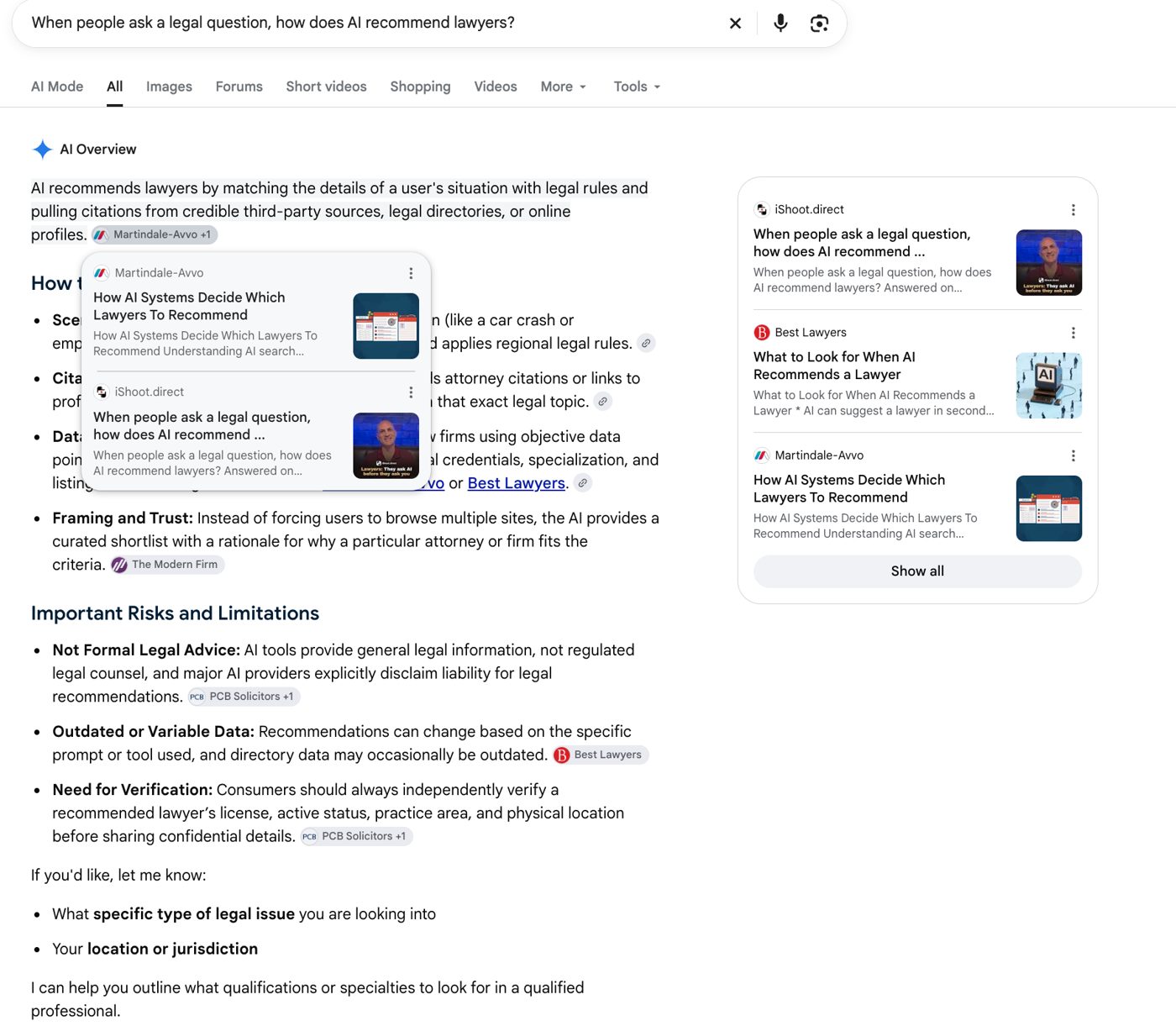
Martindale-Avvo and Best Lawyers are classic SEO winners. On this question, a one-question answer page outranked both in the AI answer.
Rebalancing the budget: keep, shift, add
| What | Why | |
|---|---|---|
| Keep | Technical SEO basics, Google Business Profile, practice-area pages | Keyword searches still happen, and AI reads the same pages |
| Shift | Generic keyword blog posts into one-question answer pages | A page built for one question is what gets quoted |
| Add | Attorney answer videos on YouTube, embedded with their transcripts | Two citable surfaces for the same answer |
iShoot's recommendation, not a published benchmark.
Search rank vs. AI citations
| Search rank (SEO) | AI citations (AEO) | |
|---|---|---|
| What it wins | A top ranking for a keyword | A citation in the answer |
| The search | “estate planning attorney” | “My contractor won't return my calls — can I recover my deposit?” |
| Trajectory | Top results get 42% of the clicks they'd get without an AI Overview[1] | 2.5 billion ChatGPT prompts a day as of July 2025[3] |
| The toolset | Inbound links and keyword-targeted pages | Question-shaped answers, named attorneys, and YouTube |
Sources
- Ahrefs (December 2025 data, reported May 2026): pages ranking first see a 58% lower average click-through rate when an AI Overview is present. businesswire.com.
- Ahrefs, study of 863,000 keywords and 4 million AI Overview URLs (2026): 38% of cited pages rank in the top 10, down from 76%. ahrefs.com.
- OpenAI usage data reported by TechCrunch, July 2025. techcrunch.com.
- Ahrefs: YouTube is the most-cited domain in Google AI Overviews (Sept 2026 snapshot); Ahrefs Brand Radar: YouTube citations in AI Overviews up 34% in six months. ahrefs.com, ahrefs.com.
More questions from law firms
- When people ask a legal question, how does AI recommend lawyers? →
- Why does AI cite other law firms instead of mine? →
- How does video help law firms get cited in AI Overviews? →
- How should a law firm structure video pages for AI? →
- How much law firm partner time should an AEO answer video consume? →
- Will AI Ever Stop Ignoring my Law Firm's Webinars or Do I Have to Start From Scratch? →