When people ask a legal question, how does AI recommend lawyers?
Answered on camera by Dan Milikow, CEO of iShoot.direct · 1:11 · Updated October 6, 2026
Led Gartner's in-house video studio for over a decade; 30,000+ videos produced since launching iShoot in 2018.
Through citations. When someone describes their situation — a crash, a firing, a parent's estate — the AI answers with the state's rule and may cite an attorney who explained that exact situation. That citation is the recommendation. Some skip the question and ask AI outright which lawyer to hire: 41.9% in one 2026 survey said they would use ChatGPT for it[4].
Watch on YouTube: Do people ask AI for a law firm, or do they just want free legal advice?
Are people getting legal advice from AI?
Yes — and often the first thing they type is the legal question itself, not a search for a lawyer.
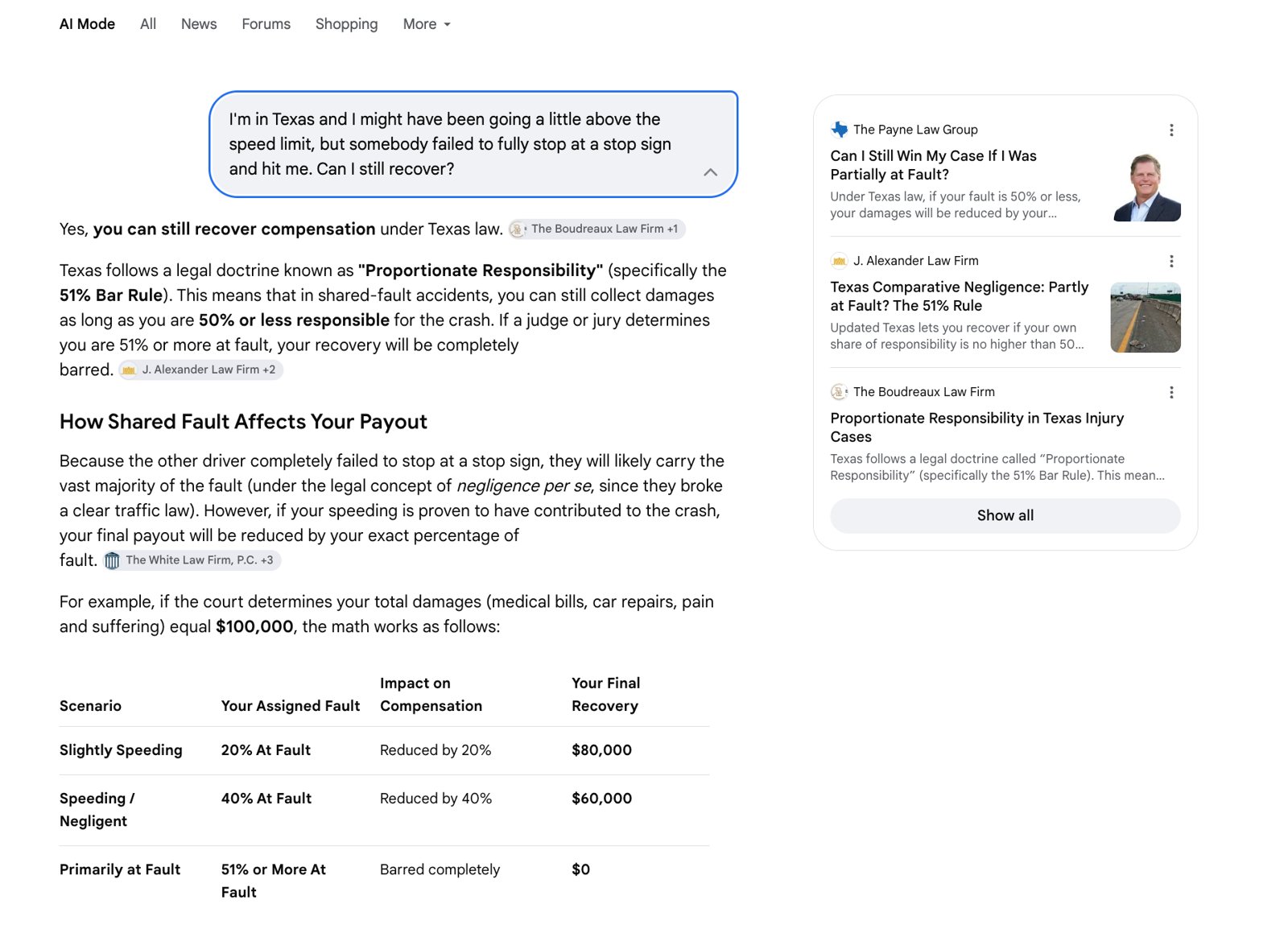
Imagine someone's been hurt in an accident, but they think it might have been partially their fault. So they ask AI: I'm in Texas and I might have been going a little above the speed limit, but somebody failed to fully stop at a stop sign and hit me. Can I still recover? That's how most legal questions start now. Not with a search for a lawyer, but with the legal question itself.
When people ask AI legal questions, does it suggest attorneys?
It can. When the answer cites sources, one may be an attorney who explained that exact situation — so the referral can arrive before any search for a lawyer.
And when the AI answers — how fault works in their state, what it does to their claim, what they can still potentially recover — it cites a named attorney walking through those issues with the state's rules. The person who asked wasn't looking for a lawyer, but they got one before they even thought about asking anyone for a referral.
How do the questions people ask AI turn into referrals?
One common path: the AI cites an attorney whose content answers the question, and the person looks that attorney up — discover on ChatGPT, hire on Google.
It's not just legal. ChatGPT gets 2.5 billion questions a day[1]. 230 million a week are about health[2] [Editor's note: OpenAI reports 230 million people a week.]. Half of all Americans admit to getting financial advice from AI[3] [Editor's note: the TD Bank survey found 55% use AI to aid financial-management decisions.]. It's happening in every domain. In fact, when was the last time you had a tough question and didn't take it to AI first? And you might have noticed an expert cited in the answer. Maybe you even searched them up. The pattern is so familiar it has a name — discover on ChatGPT, hire on Google — and the call comes before anyone has even asked their network for a referral.
Answer Engine Optimization (AEO) is the practice of structuring content so AI engines — ChatGPT, Gemini, Perplexity, and Google's AI Overviews — can extract and cite it when answering a question.
What lawyers are reporting
Whitney Thomas, a probate and estate planning attorney in San Antonio, said a few recent clients found her through AI searches — including one who started out representing themselves.
— ABA Journal, Sept 29, 2026
Dave Jochnowitz, a partner at Outten & Golden, called it “the WebMD effect on steroids”: prospects arrive saying ChatGPT told them they have a strong case.
— ABA Journal, Feb 9, 2026, citing Axios
The question from the video, asked for real
We put the transcript's Texas question to Google AI Mode. It answered with Texas's 51% bar rule and a payout table — and every source it cited was a law firm's page.
- 41.9% of consumers say they would use ChatGPT to research which lawyer to hire, up from 9% in 2023.
- The share using Google search to find an attorney fell from 86.7% to 71.9% in one year.
- 9.5% would research a law firm using only AI — no Google, Facebook, Yelp or YouTube.
iLawyerMarketing consumer survey, July 2026, n=1,110[4]. ilawyermarketing.com
The referral path, then and now
| Search era | AI era | |
|---|---|---|
| First move | Search “lawyer near me” | Ask the legal question itself |
| Who surfaces | The firm that ranks | The attorney whose answer is cited |
| When a lawyer enters the picture | After they decide to hire one | While they're still asking the question |
| What wins | Rankings and backlinks | Citable answers |
It can be. The rules cover any communication about a lawyer's services, and in New York an educational piece can become advertising if it urges viewers to hire the lawyer.
- ABA Model Rule 7.1: no false or misleading communication about a lawyer's services.
- ABA Model Rule 7.2(d): a communication about services names at least one responsible lawyer or firm, with contact information.
- New York Rule 7.1(r): a lawyer may speak or write publicly on legal topics without giving up the right to accept employment, as long as it isn't individual advice[7].
Rules vary by state. Check your state bar before publishing.
Sources
- OpenAI usage data reported via Axios and TechCrunch, July 2025: ChatGPT receives 2.5 billion prompts per day. techcrunch.com.
- OpenAI, Introducing ChatGPT Health (January 2026): more than 230 million people ask health and wellness questions on ChatGPT each week. openai.com.
- TD Bank consumer survey, reported by ABA Banking Journal (April 2026): 55% of U.S. consumers report using AI to aid financial-management decisions. bankingjournal.aba.com.
- iLawyerMarketing, What online sources do people use to research and find attorneys in 2026? (July 2026, n=1,110): 41.9% would use ChatGPT to research which lawyer to hire. ilawyermarketing.com.
- ABA Journal, How can lawyers connect with clients in the AI age? 8AMS Kaleidoscope shares some ideas (Sept 29, 2026). abajournal.com.
- ABA Journal, Are more clients turning to artificial intelligence for legal advice? (Feb 9, 2026), citing Axios. abajournal.com.
- New York Rules of Professional Conduct, Rule 7.1(r); NYSBA Ethics Opinion 830 — a lawyer may speak or write publicly on legal topics without forfeiting the right to accept resulting employment. nysba.org.
More questions from law firms
- Why does AI cite other law firms instead of mine? →
- How should a law firm structure video pages for AI? →
- How much law firm partner time should an AEO answer video consume? →
- How does video help law firms get cited in AI Overviews? →
- Will AI Ever Stop Ignoring my Law Firm's Webinars or Do I Have to Start From Scratch? →
- How do video and AI change the SEO playbook for law firms? →