Why does AI cite other law firms instead of mine?
Answered on camera by Dan Milikow, CEO of iShoot.direct · 1:06 · Updated October 6, 2026
Led Gartner's in-house video studio for over a decade; 30,000+ videos produced since launching iShoot in 2018.
Often because their pages are easier for AI to quote, and other sources — directories, reviews, press — back them up[3]. AI favors one question with a direct answer, a named attorney, and links to authorities. Webinars, podcasts and long reports rarely give it a clean answer to quote.
Watch on YouTube: Why does AI cite other law firms instead of mine?
What's special about the firms that get cited by AI?
Often, their content is structured for citation — not that they're better lawyers.
Somewhere, at this very moment, an AI is answering a question that belongs to your firm. Whether it's estate, employment, personal injury — whatever you're best at — it's citing someone else. Not because they're more talented. It's because their content is better structured to be cited.
Why do our firm's webinars, podcasts and CLE fail to get cited?
Because podcasts, webinars, and long reports are dense, linear formats that bots struggle to pull answers out of.
The dense, linear storytelling assets that you've traditionally leaned on to show expertise — the podcasts, the webinars, the three-page reports — they're just harder for the bots to pick apart.
How can I structure legal content to be cited by AI?
Structure it as a question and an answer with proper HTML markup, a named attorney as author, links to authorities, and corroboration from other sources[2].
So what does structured for citation actually mean? Well, first of all, it's a question and an answer. It's also proper HTML markup. It's a real person as an author, not the firm. There's links back to authoritative sources. There's tables and comparisons where appropriate. And the content is corroborated by other sources. That's what trust looks like to an AI bot[2].
Go watch it happen. Ask AI a question your best client would ask and see who gets cited in the answer. Then look at the page and see if you can reverse engineer why they showed up instead of you.
Use the right schema for law firms
Schema.org deprecated the Attorney type; use LegalService[6]. Markup doesn't earn a citation by itself — Google says its AI features need no special markup[1]. What it does is remove doubt about who answered and which firm stands behind the answer.
| Markup | What it tells AI |
|---|---|
LegalService | The firm — not the deprecated Attorney type |
Person, linked with worksFor | The attorney who answers: jobTitle, bar admission as hasCredential, practice areas as knowsAbout[7] |
VideoObject with Clip | The video and each question-phrased chapter[8] |
FAQPage | The question and the short answer shown on the page |
Everything in the markup must match what's visible on the page[1].
Who got cited — one real question
On Oct 6, 2026, we asked Google AI Mode: “I'm in Texas and I might have been going a little above the speed limit, but somebody failed to fully stop at a stop sign and hit me. Can I still recover?” Here's who it cited.
| Firm | Who they are | The cited page |
|---|---|---|
| The Payne Law Group | Bryan/College Station firm; eight attorneys, serving Texas since 1949 | “Can I Still Win My Case If I Was Partially at Fault?” — the client's question as the headline |
| J. Alexander Law Firm | Dallas firm founded by a 2016 law graduate | “Texas Comparative Negligence: Partly at Fault? The 51% Rule” — state and rule in the title; its snippet opens with “Updated” |
| The Boudreaux Law Firm | Houston injury firm | “Proportionate Responsibility in Texas Injury Cases” — the AI's second paragraph repeats its opening sentence nearly word for word |
None is a national brand. A young Dallas firm sat next to a 75-year-old one. Every page answered the exact question and named the Texas rule.
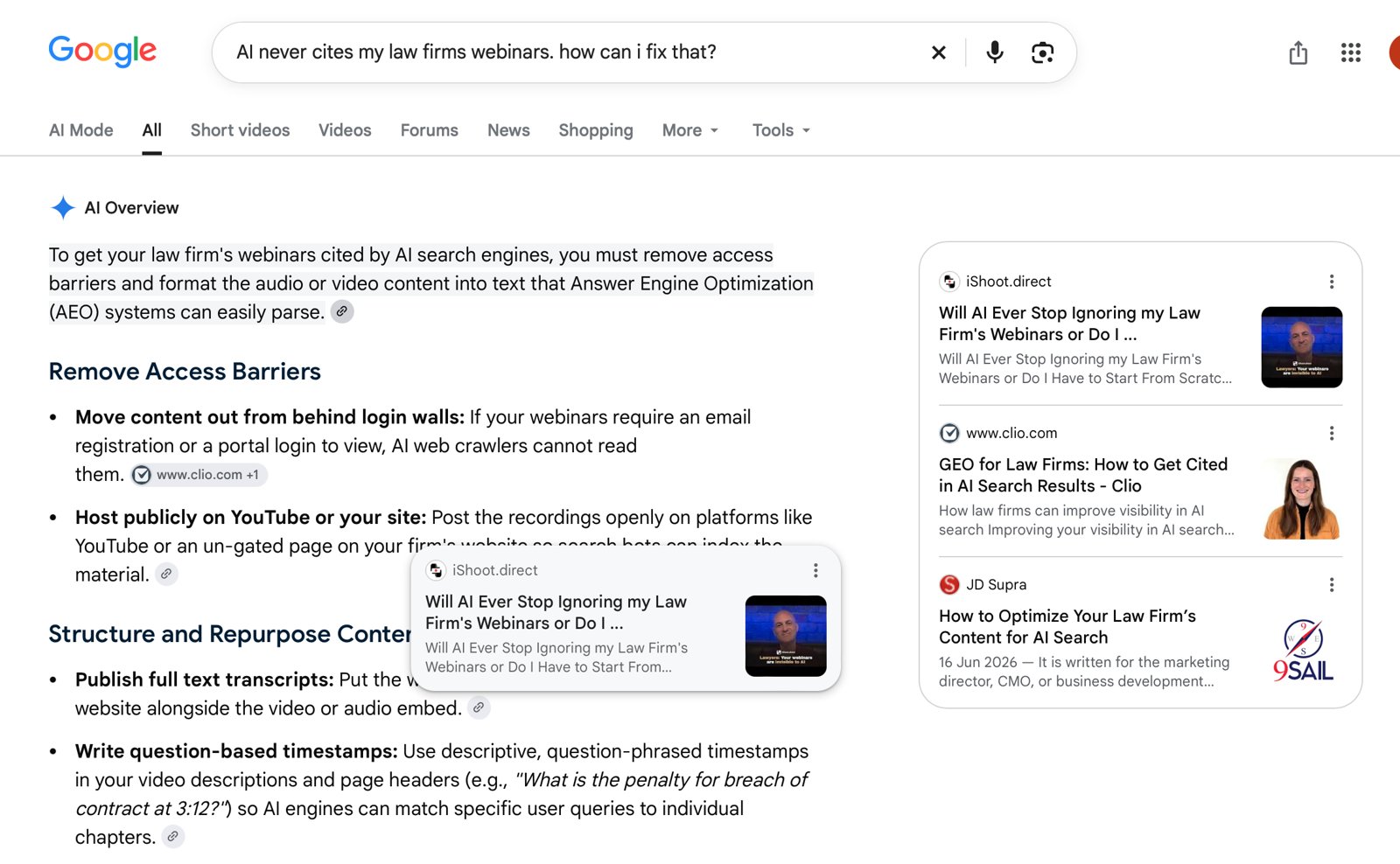
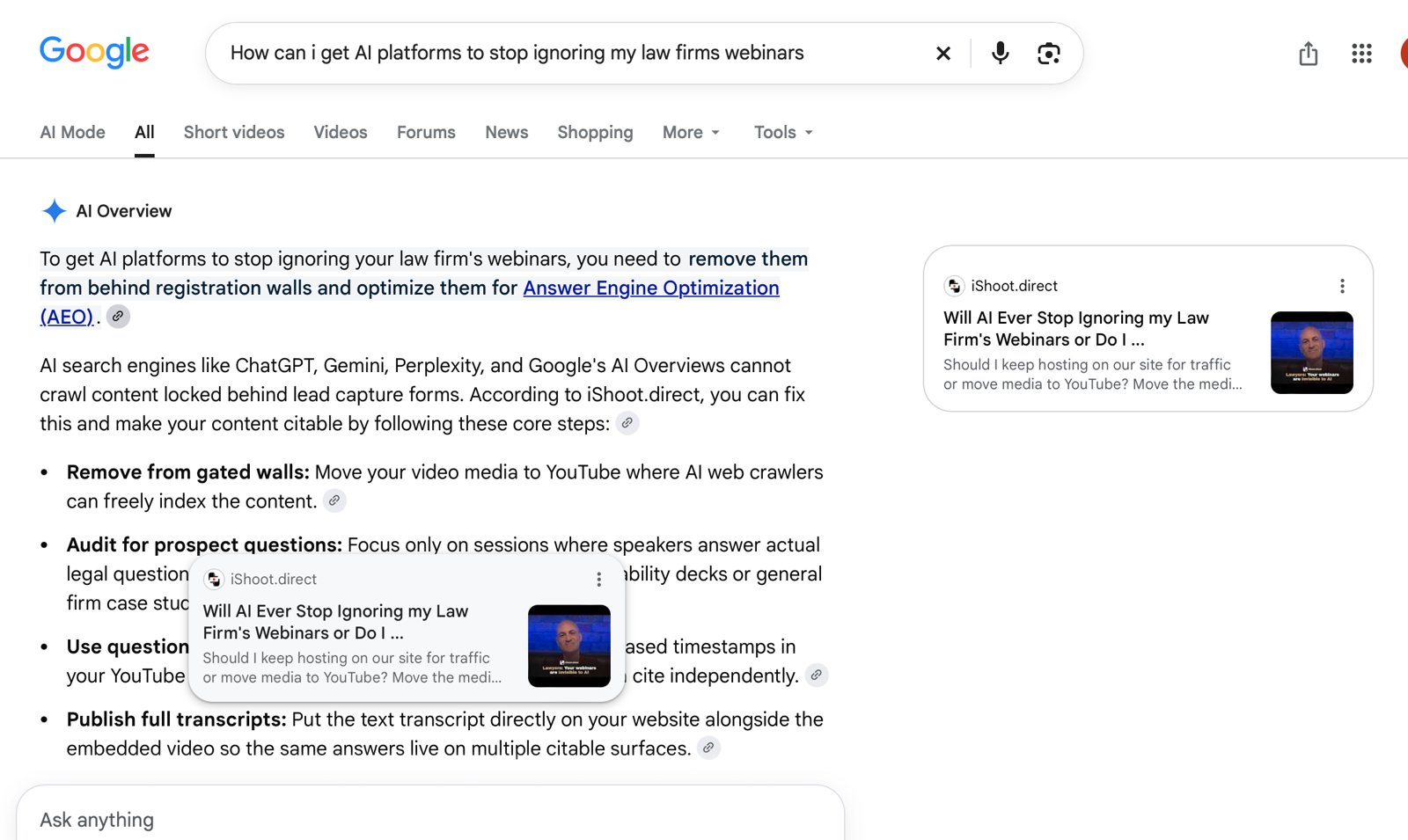
On these queries, one answer page was cited ahead of a legal software company and a legal publisher.
Where AI looks besides your site
| Finding | Number | Source |
|---|---|---|
| Super Lawyers' share of all citations | 15.6% | Forward Push, 38,000 AI searches, July 2026[3] |
| Justia's share of all citations | 13.2% | Same |
| Perplexity answers citing at least one legal directory | 96% | Same |
| Perplexity answers citing the firm's own website | 68% | Same |
| UK firms named by only one of three AI engines | 74% of 61 | Whito, Aug 2026[4] |
Your page has to be citable, and other sources have to agree with it. Both studies are agency research; check every engine, not just one.
It might be. In Seer Interactive's 2026 study of 47,097 AI citations, three in four of the most-cited pages had been updated within the past year, though only 40% were first published that recently[5]. The pages winning citations aren't necessarily new — they're kept current.
Review each answer page every three months, update it the day the law or your answer changes, and change its date only when the content changed.
Score a cited page against yours
Ask AI the question your best client asked last month, open the page it cites, and score both:
| Signal | Cited page | Your page |
|---|---|---|
| The question is the headline | ||
| The state and the rule are named | ||
| Direct answer in the first two sentences | ||
| A named attorney as author | ||
| Links to the statute, court rule or bar | ||
| Backed up elsewhere: directories, reviews, press |
Sources
- Google Search Central, AI features and your website — Google's guidance on how pages surface in AI Overviews and AI Mode; AI features need no special markup. developers.google.com.
- Google Search Central, Creating helpful, reliable, people-first content — named authorship, sourcing, and corroboration as trust signals (E-E-A-T). developers.google.com.
- Forward Push, study of 38,000 AI searches (press release, July 28, 2026) — legal directories' share of AI citations. einpresswire.com.
- Whito, AI solicitor recommendations (August 2026) — how often three AI engines name the same UK firms. whito.co.uk.
- Seer Interactive, Study: Content Recency's Impact on AI Visibility in 2026 — 47,097 citations across ChatGPT, Gemini and Perplexity (March–June 2026). seerinteractive.com.
- Schema.org, ProfessionalService — deprecation note: LegalService introduced as the more inclusive supertype of Attorney. attic.schema.org.
- Schema.org, Person — jobTitle, worksFor, knowsAbout, hasCredential. schema.org.
- Google Search Central, Video structured data — VideoObject, Clip, and key moments. developers.google.com.
More questions from law firms
- When people ask a legal question, how does AI recommend lawyers? →
- How should a law firm structure video pages for AI? →
- How much law firm partner time should an AEO answer video consume? →
- How does video help law firms get cited in AI Overviews? →
- Will AI Ever Stop Ignoring my Law Firm's Webinars or Do I Have to Start From Scratch? →
- How do video and AI change the SEO playbook for law firms? →