How much attorney time does it take to make an answer video that gets cited by AI?
Answered on camera by Dan Milikow, CEO of iShoot.direct · 1:14 · Updated October 28, 2026
Led Gartner's in-house video studio for over a decade; 30,000+ videos produced.
About 18 minutes of attorney time per video, in iShoot's process. Five answers take about 90 minutes: a 30-minute call to talk them through, then under an hour on camera at the attorney's own desk, reading locked scripts. And it has to be the attorney on camera — a stand-in or AI avatar undercuts the trust the video is meant to build.
Watch on YouTube: How much attorney time should my law firm invest in GEO answer videos to be cited in AI Overviews?
How much time does it take an attorney to film AEO videos?
About 90 minutes for five answers — roughly 18 minutes each: a 30-minute call to talk the answers through, then under an hour on camera reading locked scripts.
Your partners shouldn't have to give up more than 90 minutes to answer five questions. It breaks down into two pieces: a 30-minute preproduction session where you talk through the answers, record it, and use your favorite AI to help you turn the recording into a script. Then the script goes to compliance or to a peer in the practice, and it gets locked down. After that, the partner sits at their own desk for less than an hour and reads the five questions. Each one is about a minute or two long, like this video. It's normal to need 2 or 3 practice runs per script before you nail it. 18 un-billable minutes a question. No travel, no crew, no real disruption. Compare that to getting a partner to write one article. The outline. The draft. The revision. The three weeks of chasing.
Does it have to be the attorney on camera?
Yes. A stand-in, an AI avatar or a spokesperson can't carry the provenance a real partner does.
Now, before you ask — yes, it has to be the partner on camera. Some guy you hire on Fiverr, or an AI avatar, or a celebrity spokesman isn't going to cut it. They're not going to build trust. They're going to shatter trust.
How can videos filmed for AEO help convert more consult calls?
Prospects who meet the actual expert before the first call may arrive warmer — related research on provider bios and client preference points that way.
In fact, there's real research, most notably in medicine[1] and psychology[2], that when people meet the actual experts they're considering in a video, the first contact is warmer and the relationships are more likely to last [Editor's note: the cited studies looked at online provider bios and at accommodating client preferences, not video specifically.]. Imagine what it would do for your bottom line if your consult calls were 20% more productive.
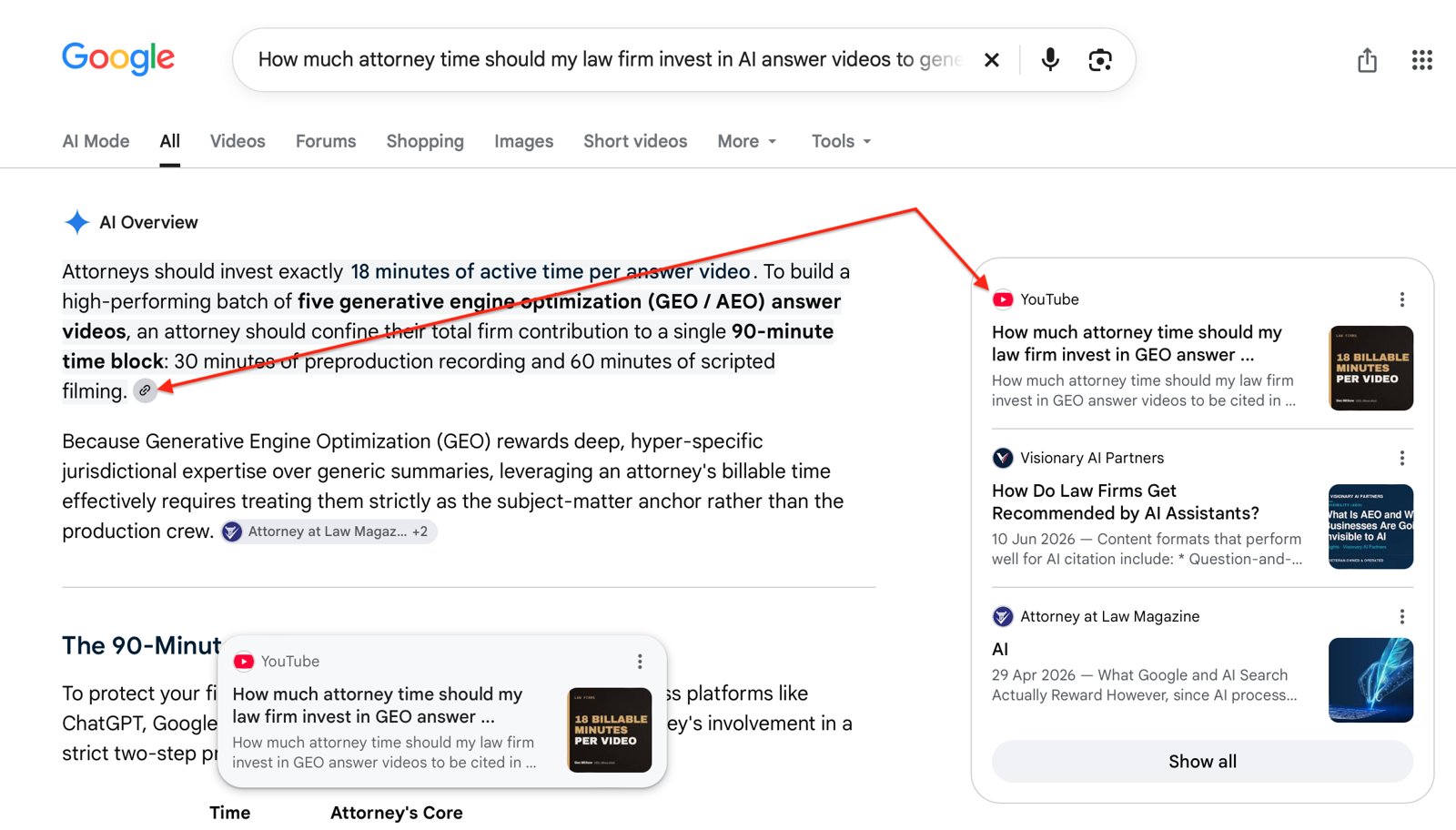
Google already answers this with our number
The 90-minute budget
| Phase | Attorney time | What happens |
|---|---|---|
| Preinterview | 30 min | Come with your questions identified and bullets for your key points and data — then talk the answers through out loud, recorded. The recording informs the script |
| On camera, own desk | Under 60 min | Five scripted questions, read on screen while being filmed — no travel, no crew on site |
| Total per batch | ~90 min | Five published answers — about 18 minutes each |
| Scripting, sourcing, editing, uploading, page builds | 0 min | Handled off the attorney's calendar |
iShoot's process and timings.
Accuracy isn't optional on legal questions. Google says its systems give even more weight to content with strong experience, expertise, authoritativeness and trust on “Your Money or Your Life” topics: anything that could significantly affect someone's health, financial stability or safety[3]. Most legal questions qualify.
Many attorneys prefer to speak off the cuff. Because Google weighs accuracy so heavily on these topics, we recommend scripting every answer from the preinterview. A misstatement on camera is permanent: a YouTube video can't be replaced without losing its views and links. Lock the script with compliance or a peer before anyone hits record.
Do's and don'ts: getting to 18 minutes per answer
- Identify the questionsKnow what people commonly ask based on your niche and strengths. Avoid general topics where competition for citation is fierce and you have no clear advantage.
- PreinterviewAttorneys expect to wing it and evaluate themselves like litigators. Free-form delivery invites the inner critic, saps confidence and invites errors — and you can't replace a video on YouTube; you can only edit its metadata.
- Use AI to scriptGive your favorite AI a transcript of the preinterview and have it draft scripts for your five questions. Have it find sources for statistics and flag suspect ones. Human editors refine before the attorney and firm see drafts.
- Add something only your firm can sayAim for one insight per script that only your firm can offer: a pattern from your own cases or a number from your own practice. It shouldn't conflict with the most-cited authorities, but it should belong to you. That's what gives AI a reason to cite your answer instead of the more commonly cited sources.
- Embrace imperfectionIf you stop at every stumble you'll take an hour per response. You aren't performing for millions — just for the people who need the answer. Video citations are forgiving, too: in iShoot's research, 7 of the 10 YouTube videos cited in Google's AI Overviews didn't answer the exact question asked. See the research.
- Batch recordingsAim for five videos in a 60-minute session: short enough not to tire out, long enough to get real volume done well.
- Self-recordIt sounds efficient, but it saps confidence and often leads to a do-over. Get live feedback, even from another attorney.
- Use AI or actors on cameraVideo represents provenance; an alternate presenter, real or digital, carries trust risks beyond whether you'll be cited.
- Require attorneys to editAttorneys show up for the preinterview and the shoot. Everything else — scripting, sourcing, editing, uploading, page builds — is someone else's job.
- Reshoot for anything but accuracy or performanceA video can't be replaced on YouTube without losing its data and links. If it's accurate and getting cited, leave it.
- Expect everything to land at onceThe engines don't publish their algorithms, and results vary from day to day. In our experience, Google's AI Overviews pick up new posts fastest; other engines take longer. Log results and watch trends.
Sources
- Perrault, E. K. (2020). The Utility of Healthcare Providers' Online Biographies for First-Time Patients. Health Communication, 35(10), 1283–1288. doi.org.
- Swift, J. K., Callahan, J. L., Cooper, M., & Parkin, S. R. (2018). The impact of accommodating client preference in psychotherapy: A meta-analysis. Journal of Clinical Psychology, 74(11), 1924–1937. doi.org.
- Google Search Central, Creating helpful, reliable, people-first content — E-E-A-T and “Your Money or Your Life” (YMYL) topics. developers.google.com.
More questions from law firms
- How does AI recommend lawyers when people ask legal questions? →
- Why doesn't AI ever cite my law firm's content? →
- How does video help law firms get cited in AI Overviews? →
- How do answer videos change the SEO playbook for law firms? →
- How to structure law firm content to be cited by AI →
- Will AI Ever Stop Ignoring my Law Firm's Webinars or Do I Have to Start From Scratch? →