Is everyone asking AI their tax questions before they call my CPA firm?
Answered on camera by Dan Milikow, CEO of iShoot.direct · 1:25 · Updated October 6, 2026
Led Gartner's in-house video studio for over a decade; 30,000+ videos produced since launching iShoot in 2018.
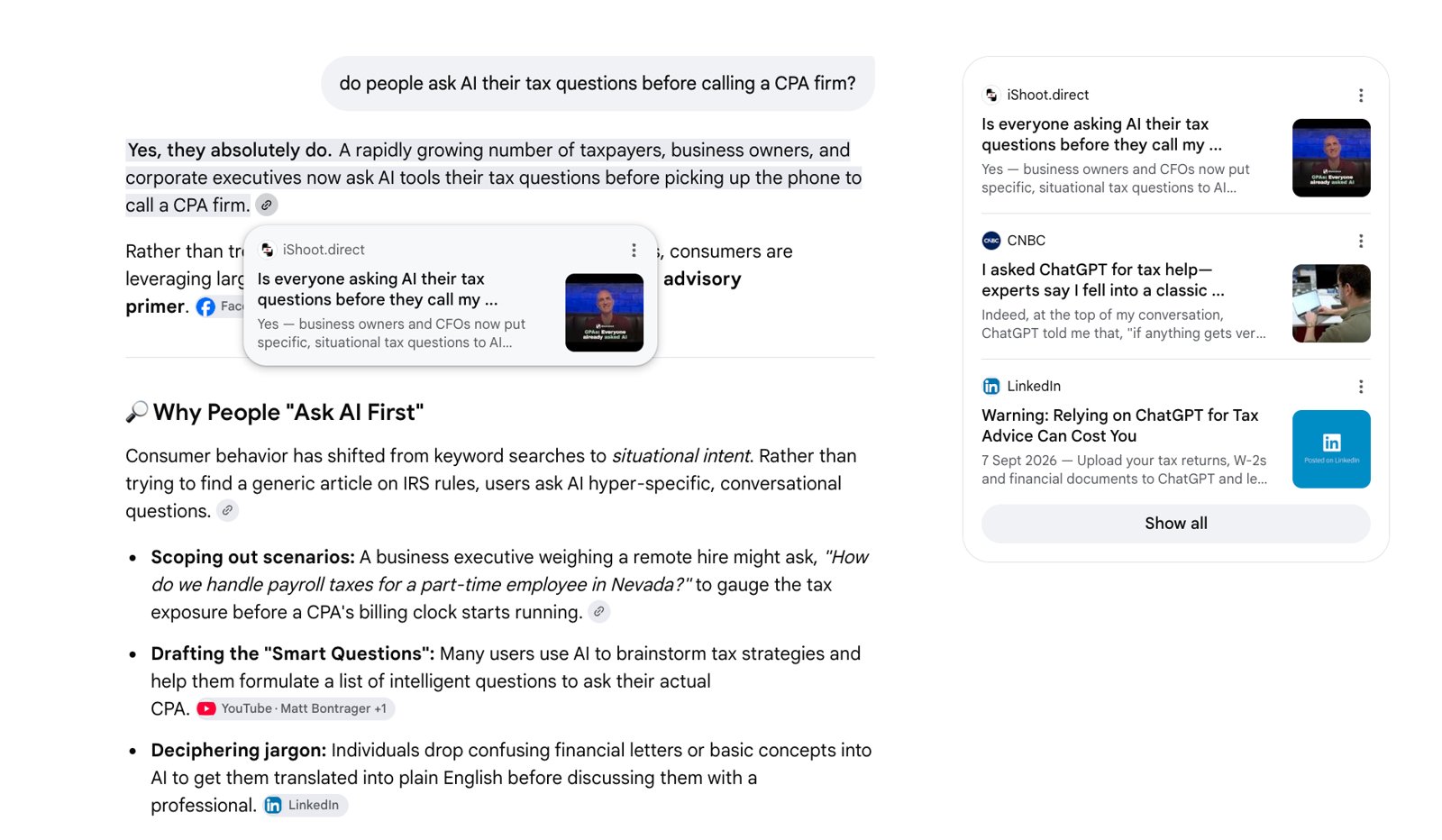
Not everyone, but enough to matter. At least 1 in 5 Americans planned to use AI on their taxes this year[3], and business owners now put specific, situational tax questions to AI before calling anyone. Some of those answers name a CPA: firms like LBMC and Withum now track clients who arrived that way[10].
Watch on YouTube: Is everyone asking AI their tax questions before they call my CPA firm?
Are people getting tax advice from AI?
Yes — business owners and CFOs now put specific, situational tax questions to AI before they ever call an accountant.
Imagine a CFO is weighing a remote hire in another state and wants to know the tax exposure before it's real. So before the hire happens, before anyone calls an accountant, they run it by AI: how do we handle payroll taxes for a remote part-time employee in Nevada? Look at that question. That's not a keyword search. It's specific, situational — half a sentence of context. And that's typical now. The search box used to find sources; now it finds answers.
When people ask AI accounting questions, does it suggest CPAs?
AI recommends CPAs by citing the named CPA whose content answers the exact question asked.
AI works the problem — registration, withholding, whether one hire creates a filing obligation — and the answer points to a named CPA laying it out for one part-time hire in Nevada. The CFO wasn't shopping for an accountant. One showed up inside the answer anyway.
Are people using AI to file their taxes?
Yes — at least 1 in 5 Americans planned to use AI to help with their tax filings this year[3].
Let's face it, everyone is asking AI. 2.5 billion questions hit ChatGPT daily[1]. Health alone is 230 million questions a week on ChatGPT[2]. Here's a tough stat for CPAs: at least 1 in 5 Americans are planning to use AI in their tax filings this year[3]. Think about your own behavior. Have you asked AI any tough questions in the last couple of days? Maybe the last couple of hours? If you did, you might have noticed the experts cited in the answer. Maybe you even searched them up. It's a pattern so common it has a name: discover on ChatGPT, hire on Google. So when a citation names a CPA, the call happens before anyone even started looking for a referral.
Who's asking, and what they type
| Buyer | What they ask AI | Source |
|---|---|---|
| CFO weighing a hire | “How do we handle payroll taxes for a remote part-time employee in Nevada?” | Example from our video |
| Crypto holder | “I got a tax notice and haven't done my crypto accounting for five years.” | Camuso CPA, via Accounting Today[10] |
| VC firm mid-deal | Their exact deal scenario — then a comparison of Withum with three or four other CPA firms | Withum, via Accounting Today[10] |
What firms see in their own lead data
| Firm | What they reported |
|---|---|
| Camuso CPA (crypto specialist) | AI-referred prospects are 15–20% of all leads |
| Certum Solutions (North Carolina) | AI referrals are 10–20% of leads, nearly all wanting accounting-software training |
| LBMC (Top 50) | AI-attributed leads about 5–7% of the total, up from zero a year earlier; AI traffic up 200% |
| Withum (Top 25) | A VC client compared Withum with three or four CPA firms in ChatGPT and had decided before the sales call |
These firms said that, in general, AI-referred clients started with a specific question, not “find me a CPA.” Source: Accounting Today, Oct 31, 2025.
Anecdotal evidence
| What CPAs are seeing | The story | Source |
|---|---|---|
| Clients who think they know everything | Tax firms in the US and Europe report clients arriving with AI-prepared returns, asking for a review rather than a return | [4] |
| A CNBC reporter ran their taxes through ChatGPT — doing what 1 in 5 taxpayers now do[3] — before having a CPA review the AI's work | [5] | |
| Bad tax advice from AI | A taxpayer asked ChatGPT to work SEP contributions and Roth eligibility, got three different numbers in three tries, and warned r/tax: use a qualified advisor. The CPAs in the thread weren't surprised | [6] |
| The CNBC reporter's ChatGPT answer was “possibly correct but incomplete” — CPA Miklos Ringbauer caught a W-2 check the AI had waved off and taxable events it never flagged | [5] | |
| Clients expecting AI discounts | KPMG pushed its own auditor, Grant Thornton UK, from $416K to $357K — a 14% cut — arguing AI savings belong to the client, for AI the auditor paid to build | [7] |
| Top US firms (KPMG, PwC, RSM) are redesigning pricing because AI compresses billable hours faster than hourly models can absorb | [8] | |
| 71% of clients now prefer fixed fees; a task that took five hours takes one, and most small firms haven't repriced | [9] |
Fewer taxpayers would consider trusting AI over a tax professional: 37% in 2026, down from 43% in 2025[11]. Asking AI isn't the same as trusting it over a professional.
Sources
- OpenAI usage data reported via Axios, July 2025: ChatGPT receives 2.5 billion prompts per day. techcrunch.com.
- OpenAI, Introducing ChatGPT Health (January 2026): more than 230 million people ask health and wellness questions on ChatGPT each week. openai.com.
- IPX1031, 2026 Tax Procrastinators Survey: 21% of Americans planned to use AI to help file their taxes this year. kxan.com.
- Americans Overseas, US Tax Return ChatGPT: Why “Almost Right” Still Means Wrong (November 2025): tax firms report clients arriving with AI-prepared returns asking for a review. americansoverseas.org.
- CNBC, I asked ChatGPT for tax help — experts say I fell into a classic trap (March 31, 2026): CPA Miklos Ringbauer found the AI's answer “possibly correct but incomplete.” cnbc.com.
- Benzinga, They Thought ChatGPT Would Give Them Sound Tax Advice, But After Trying It, They Warn: Stick To Your Tax Software Or A Qualified Tax Advisor (February 2026). benzinga.com.
- The Finance Story, KPMG forced Auditor for a 14% AI Discount… Will the “Billable Hour” die? (February 2026): KPMG pushed Grant Thornton from $416K to $357K. thefinancestory.com.
- Bloomberg Tax, AI Efficiency Gains Push Accounting Firms to Reimagine Pricing (March 2026): KPMG, PwC and RSM are moving away from hourly billing. news.bloombergtax.com.
- Forbes, Firms Adopted AI In Record Numbers. Selling Hours Got Harder (August 19, 2026): 71% of clients prefer fixed fees. forbes.com.
- Accounting Today, AI a growing source of new client referrals (October 31, 2025): named CPA firms report AI-referred leads making up a growing share of new business. accountingtoday.com.
- Journal of Accountancy, AI loses ground to pros as taxpayers rethink who should do their taxes (February 2026), Invoice Home survey: 37% would consider trusting AI over a tax professional, down from 43% in 2025. journalofaccountancy.com.
More questions from accounting firms
- Why doesn't AI cite my CPA firm's content? →
- What's the simple recipe for getting my CPA firm's content into AI answers? →
- How much CPA time will I need to get my accounting firm to show up in AI Overviews? →
- Can YouTube Really Help My Firm's CPAs Get Cited in AI Overviews? →
- Why are my CPA firm's podcasts invisible to AI? Do I need to start over again? →
- Will AI help or hurt a referral-driven CPA firm? →